

Most SEO frameworks are built around a simple premise: find what Google wants, give it that. It’s reactive by nature. Someone updates the algorithm, agencies scramble to adjust, rankings shift, clients panic. The whole industry has been running in this loop for over two decades, and while it’s produced plenty of tactical wins, it’s also produced a lot of fragile results that collapse the moment the ground shifts.
ThatWare decided to approach things differently. And if you spend any time studying how their methodology actually works, it’s clear this isn’t just a rebranding of standard SEO practices with “AI” bolted on for marketing appeal. There’s genuine architecture here — a framework built around intelligence, not instinct.
What Makes It “Hyper”?
The word “Hyper” in this context doesn’t mean faster or louder. It refers to something closer to a systems-level approach — multiple AI-powered layers operating simultaneously across a website, rather than isolated optimizations applied one tactic at a time.
Traditional SEO tends to work in silos. Technical audit here, keyword research there, content strategy in another spreadsheet, link building on a separate track. These things rarely talk to each other in real time. The result is an optimization process that’s perpetually behind — always reacting to what already happened.
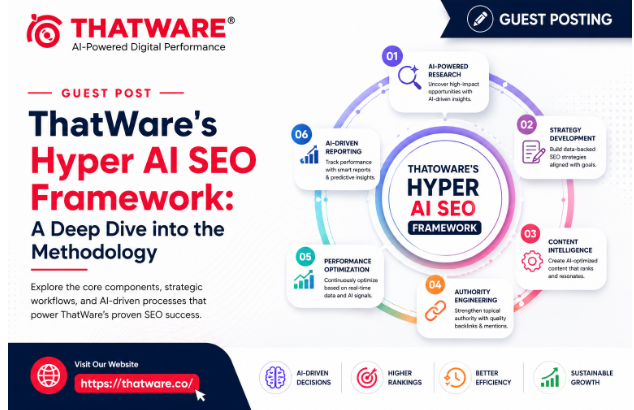
ThatWare’s Hyper AI SEO framework is designed to work as an integrated loop. Data from search behavior feeds into content recommendations. Content performance feeds back into technical priorities. Semantic entity analysis informs link strategy. Every layer informs every other layer, and AI sits at the center processing the connections that no human team could track manually.
The NLP and Entity Layer
One of the most technically interesting parts of the methodology is how it handles natural language processing. Rather than treating a page as a collection of keywords to be matched against queries, the framework maps pages as semantic entities — nodes in a knowledge graph that have relationships with other concepts, topics, and entities across the web.
This matters because Google doesn’t just read words anymore. It interprets meaning. It understands that a page about “running shoes” is related to “marathon training,” “foot strike patterns,” “pronation,” and “trail vs road surfaces.” A page that only matches the primary keyword but ignores the surrounding semantic context is going to underperform against a page that demonstrates genuine topical depth.
ThatWare’s approach maps these relationships explicitly, then audits content against them. The output isn’t “add this keyword three more times.” It’s “your content needs to establish this entity relationship because competitors ranking above you have it and you don’t.”
Predictive Capability: Acting Before the Algorithm Does
Here’s something most frameworks don’t even attempt: predicting ranking movements before they happen. ThatWare uses behavioral and contextual data to model how algorithm changes and shifts in search intent are likely to affect a site’s rankings over time. This isn’t guesswork — it’s pattern recognition across enough data points that emerging trends become visible before they hit.
In practice, this means the framework can recommend changes not because rankings dropped, but because the data suggests they’re about to drop if certain gaps aren’t addressed. That kind of lead time completely changes the economics of SEO. Instead of spending budget on damage control, it gets spent on preemptive optimization — which is both cheaper and more effective.
Technical Intelligence
The technical layer of the ThatWare AI SEO framework goes well beyond crawl reports and Core Web Vitals dashboards. It uses machine learning to prioritize which technical issues actually affect ranking — because not every crawl error is equally damaging, and not every speed improvement yields measurable results.
This triage capability is genuinely valuable. Most technical audits produce hundreds of recommendations with no clear order of importance. Development teams get a sprawling list and have to guess where to start. ThatWare’s framework ranks technical fixes by projected ranking impact, which means the first fixes implemented tend to be the ones that actually move the needle.
Content Production as a System, Not an Event
Perhaps the biggest philosophical difference from traditional SEO is how ThatWare treats content. Standard approaches treat content as deliverables — pieces to be published, checked off, and replaced when performance dips. The Hyper AI framework treats content as a continuously evolving asset.
That means pages get monitored, updated, and re-optimized based on live performance data. A page that was performing well six months ago gets flagged if it’s starting to show decay signals. A topic cluster that’s gaining traction in search gets prioritized for expansion. The system doesn’t wait for the client to notice something’s wrong. It acts ahead of the curve.
Results That Compound
The strongest argument for any framework isn’t the methodology — it’s the outcomes. What’s striking about ThatWare’s documented results is the compounding nature of the growth. Organic traffic doesn’t just climb; it accelerates over time as the various layers of optimization reinforce each other. That’s the signature of a system that actually integrates its components, rather than running parallel tactics that never quite add up to more than the sum of their parts.
This is what separates a genuine AI-powered framework from an agency that runs standard SEO and calls it AI because they use a keyword tool. The integration, the feedback loops, the predictive intelligence — these create a fundamentally different kind of optimization. Slower to establish than quick-win tactics, but far more durable and far less vulnerable to the next algorithm update that scrambles everyone else’s rankings.
For businesses serious about organic growth, understanding how this methodology works isn’t just interesting — it’s becoming necessary.